
Custom Clothing Labels and Hang Tags for Private Label Brands
A label is the first thing a customer reads and the last thing they see before they decide whether your brand feels real. It carries your name, your sizing, your care instructions and the legal details retailers insist on. Fashion Flair is a clothing manufacturer based in Sialkot, Pakistan. We make custom clothing labels and hang tags for private label brands and attach them to the garments we manufacture for you, with one contact and one timeline.
This guide explains the label types, how to choose between them, where each one goes, what a label must contain, and what to send us for a quote.
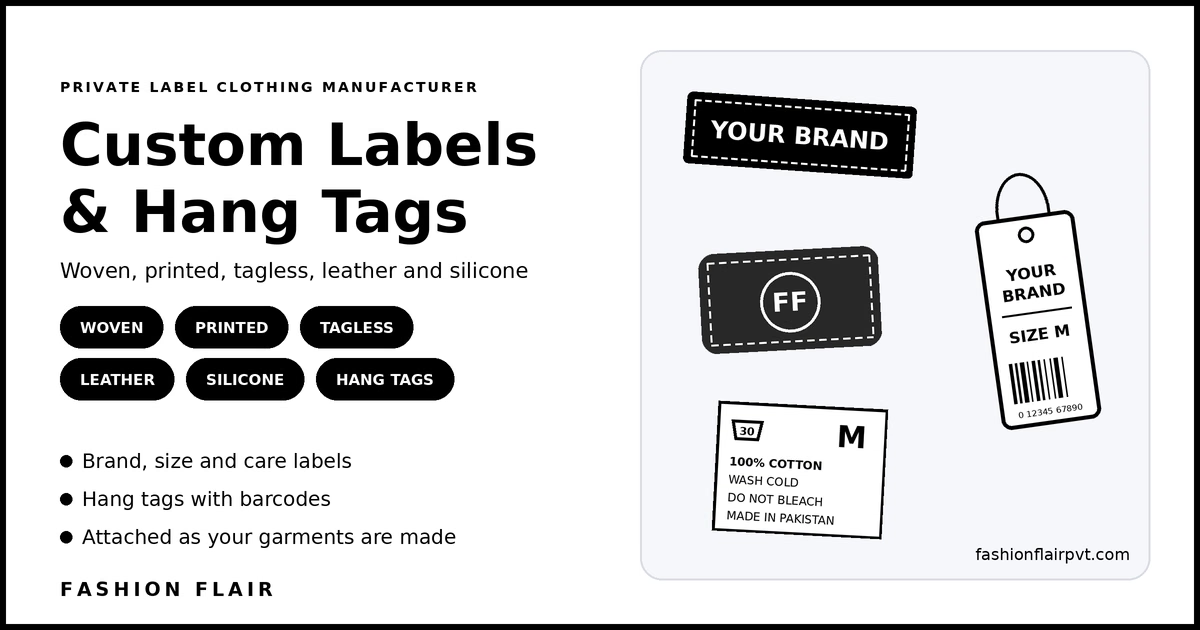
Labels and Hang Tags at a Glance
| Label types | Woven, printed, heat transfer (tagless), leather and PU patches, rubber, silicone and TPU |
|---|---|
| Hang tags | Cardstock, paperboard, plastic or fabric tags with string, cord or plastic fasteners |
| Folds and attachment | Straight cut, end fold, centre fold, mitre fold and Manhattan fold |
| Free before production | Artwork check and mockup |
| Garment MOQ | 30 pieces per design |
| Lead time | Depends on label type and quantity; share your design for an exact turnaround |
| Ships to | Worldwide |
Why Custom Clothing Labels and Hang Tags Matter
Labels do four jobs at once, and each one affects how your brand is judged.
- Brand identity. Your logo inside the neck or on a sleeve flag turns a generic garment into your product.
- Information. Size, fabric content and care instructions help customers use and wash the garment correctly.
- Compliance. Many markets require fibre content, country of origin and care details to be sewn in. Missing them can stop a shipment.
- Retail presentation. A hang tag carries your story, price and barcode, and it often decides whether a shopper picks the garment up.
Types of Custom Clothing Labels and Hang Tags We Make
Our custom clothing labels and hang tags differ in look, feel, durability and cost. Here is what each type offers.
Woven Labels
Woven labels are the standard for premium, durable branding. Threads are woven on a loom to form your artwork and text, so the design is part of the label and does not rub off. There are three common finishes:
- Damask. The most popular woven label. It is soft and flexible, and fine threads capture good detail. Ideal for main brand labels and neck labels.
- Satin. A smooth, glossy surface that feels gentle on the skin, so it suits lingerie, activewear and baby clothing.
- Taffeta. Crisp and ribbon-like, durable and cost-effective. Often used for care labels and side-seam flags.
Printed Labels
Artwork or care text is printed directly on a fabric base. This works well for fine text, multi-colour artwork and care labels with long wording.
- Printed satin or polyester. Smooth and clear, good for detailed graphics, many colours and small text.
- Cotton or canvas. A natural, vintage or eco-minded look. Popular for denim, sustainable ranges and casual streetwear.
Heat Transfer (Tagless) Labels
The label design is printed on film or transfer paper and pressed straight onto the inside of the garment. There is no tag to scratch or chafe, so the finish is smooth and clean. Best for: activewear, rash guards, jerseys, underwear and compression wear.
Leather and Faux Leather (PU) Patches
Durable patches attached by stitching, rivets or adhesive. They come in real leather, PU or suede, often embossed, debossed or foil-stamped with a logo. Best for: jeans, jackets, outerwear and hats.
Rubber, Silicone and TPU Labels
Moulded, raised labels with a modern, tactile look. They resist weather, water and washing. Best for: outerwear, fight wear, gym wear, bags, footwear and waterproof garments.
Hang Tags (Swing Tags)
Hang tags hang on the outside of the garment and are made from cardstock, paperboard, plastic or fabric. They attach with string, cord or a plastic fastener. They carry your brand story, price, barcode, size and materials, and they set the tone before the garment is touched.
Which Label Fits Your Garment?
| Garment | Label that usually works best |
|---|---|
| Activewear and gym wear | Heat transfer (tagless) or soft satin labels, plus a hang tag |
| Rash guards, jerseys and compression | Heat transfer, or silicone and TPU for exterior branding |
| Streetwear hoodies and tees | Woven damask neck label, a flag tag and a hang tag |
| Denim, jackets and outerwear | Leather or PU patch, with a woven care label inside |
| Eco and vintage ranges | Cotton or canvas printed label |
| Premium collections | Fine damask or satin woven label with a quality paperboard hang tag |
Developing a specific line? Tell us the garment, fabric and price point, and we will recommend a material, fold and attachment method for your custom clothing labels and hang tags, ready for your tech pack.
Label Types by Purpose and Placement
| Label | Purpose | Common placement |
|---|---|---|
| Main brand label | Shows your logo and identity | Inside back neck, outer waistband, lower hem, chest |
| Size label | Shows size (S, M, L, XL or numeric) | Neck label fold, inner seam or loop tag |
| Care and content label | Fabric content, washing instructions, country of origin | Inner left side seam, near the hem |
| Flag or hem tag | Subtle outside branding | Sleeve cuff, pocket edge, hemline, waistband seam |
| Patch or badge | A bold focal point or emblem | Sleeve, chest, outer back waistband |
Label Folds and Attachment Styles
How a label is cut and folded changes how it feels and how it is sewn in.
- Straight cut (flat). The edges are sealed, and the label is stitched on all four sides or along the top and bottom.
- End fold. The left and right ends fold back under, giving soft, finished edges that sit comfortably against the skin.
- Centre fold (loop fold). The label is folded in half and the cut ends are stitched into a seam. It is common at neck seams and side seams.
- Mitre fold. The ends fold up at 45° to form a loop at the top, so the garment can be hung.
- Manhattan fold. A centre fold with extra folds that cover the raw edges, which is useful where stitching will show.
What Your Label Must Contain
Labelling rules depend on the country where you sell. As a general guide, most markets expect:
- Fibre content, for example “100% cotton” or “80% cotton, 20% polyester”
- Country of origin
- Care instructions, often using international care symbols (ISO 3758 or ASTM D5489)
- Size
- Brand or importer identification, which some countries require
Requirements differ between the United States, the European Union, the United Kingdom, Canada and other markets, and they change over time. Check the current rules for your destination, and tell us your market before production so we can print what you need. We make the custom clothing labels and hang tags you specify, and we do not give legal advice.
Design Tips for Custom Clothing Labels and Hang Tags
- Think about comfort first. A scratchy neck label is the most common complaint. Use soft satin, a fold that sits flat, or a tagless heat transfer.
- Keep small text readable. Woven labels cannot hold very fine type. Use a printed label for long care text, or simplify the wording.
- Limit colours on woven labels. Fewer colours give a cleaner look and lower cost.
- Choose contrast. Light thread on a light label disappears. Pick colours that stand out.
- Match the label to the garment. A premium damask label on a cheap fabric, or a plain care label on a luxury piece, feels off.
- Plan the hang tag layout. Leave room for a price sticker and a clear barcode area.
How Our Label and Hang Tag Process Works
- Send your brief. Garment type, label types, placements, text, artwork and quantity. Vector files (AI, EPS, PDF) are best.
- Artwork check and mockup. We review spelling, size and colours, suggest the best label and fold, and send a free mockup.
- Proof approval. You approve the final artwork before anything is produced.
- Label and tag production. Labels and hang tags are made to the approved design.
- Attachment during manufacturing. Labels are sewn or applied at the agreed position as your garments are made. Hang tags are attached at packing.
- Quality control. See below.
- Packing and shipping. Garments are packed with their labels and tags, and shipped worldwide.
For the full picture of an order, read our manufacturing process and sample policy.
Our Quality Control
Quality control is what protects your brand when you order custom clothing labels and hang tags. Every order goes through our three-level QC system. For labels and tags, the checks include:
- Content accuracy, with spelling, sizes and fibre content matched to your approved proof
- Colour and detail against your approved sample
- Placement, measured from a fixed point so labels sit straight and in the same spot on every garment
- Secure attachment, with stitching intact and edges that do not fray
- Comfort, so edges do not scratch
- Hang tag condition, with correct fasteners and a readable barcode
Rejected pieces are removed, not shipped.
What Affects Label and Hang Tag Cost
Every maker of custom clothing labels and hang tags prices a little differently. We quote per project, because the price depends on a few clear factors:
- Label type and material, since leather, silicone and fine woven labels cost more than printed ones
- Size and number of colours or details
- Fold and attachment style
- Number of labels per garment, such as brand, size, care and flag
- Hang tag material, finish and size
- Quantity, as setup costs are spread across more pieces
For more on pricing, see our price guide. We give a written quote before any work starts, so there are no surprise charges.
Who We Make Custom Clothing Labels and Hang Tags For
We work with clothing startups, streetwear and activewear labels, sports teams and schools, and companies ordering branded apparel. For activewear, see our private label activewear manufacturing. For a full brand build, see our private label clothing manufacturing service.
Why Brands Choose Fashion Flair for Custom Clothing Labels and Hang Tags
- Labels, tags and garments in one order. The team that makes your garment also attaches your labels, so placement stays consistent.
- Honest advice. We recommend the label that suits your fabric and budget, not the most expensive one.
- Proof before production. You approve the artwork and wording first.
- Production updates. Photos and videos during the run.
- A registered company you can verify. Fashion Flair (SMC-Private) Limited, SECP Incorporation No. 0269917, FBR NTN E862604, SCCI membership C-4058.
- Worldwide shipping, with options and timelines shared before production.
Frequently Asked Questions
What is your minimum order for custom clothing labels and hang tags?
Labels and tags are made for the garments we manufacture for you, and our garment MOQ is 30 pieces per design. Label quantities follow your order, and we confirm them in your quote.
What is the difference between woven and printed labels?
Woven labels are made by weaving thread into the design, so they are durable and look premium. Printed labels have the design printed on fabric, which suits fine text, many colours and lower budgets.
What is a damask label?
Damask is the most common woven label. It is soft and flexible, and it holds fine detail well, which makes it a good choice for brand and neck labels.
What is a tagless label?
A tagless label is printed on a heat transfer film and pressed straight onto the garment. With no tag to scratch, it is popular for activewear, underwear and compression wear.
Which label is best for activewear?
Heat transfer labels or soft satin labels are the most comfortable. For exterior branding, silicone or TPU labels resist sweat and washing well.
Do I need a care label?
Most markets require care and fibre content information on garments for sale. Rules differ by country, so check your market’s requirements and tell us what to include.
Can you add hang tags with barcodes and prices?
Yes. Hang tags can carry your brand story, size, barcode and price information. Send us the layout or ask us to suggest one.
What is the difference between a centre fold and a mitre fold?
A centre fold is folded in half and stitched into a seam. A mitre fold has its ends folded up at 45° to form a loop, often used so the garment can be hung.
What artwork files do you need?
Vector files (AI, EPS or PDF) are ideal. If you only have a sketch or a low-quality logo, our design team can redraw it for you.
Can I get a sample before bulk production?
Yes. You approve a proof and a sample before bulk. See our sample policy for details on cost and timing.
Can I send my own blank garments to be labelled?
No. We are a manufacturer, so we attach labels and tags only to garments we make for your order. That keeps placement and quality consistent from the first piece to the last.
How long does production take?
It depends on the label type and quantity. Share your design or mockup and we will give you an exact turnaround, confirmed in writing before we start.
Do you ship internationally?
Yes. As a manufacturer of custom clothing labels and hang tags working with brands abroad, we ship worldwide and share shipping options and estimated delivery times before production begins.
Ready to Brand Your Collection?
Send us your garment type, label ideas and target quantity. We will reply with a mockup and a clear quote within 24 hours on working days. Tell us about your project and see why brands choose us for custom clothing labels and hang tags.
Or email info@fashionflairpvt.com