
Custom Rubber Patches for Clothing Brands: PVC and Silicone, 2D and 3D
Some logos are meant to be touched. Custom rubber patches give your brand a raised, glossy or matte, colour-rich emblem that shrugs off rain, sun and washing. Fashion Flair is a clothing manufacturer based in Sialkot, Pakistan. We make custom rubber patches for private label brands and attach them to the hoodies, jackets, caps, bags and sportswear we manufacture for you, with one contact and one timeline.
This guide explains what rubber patches are made of, how 2D and 3D styles differ, which backing to choose, how we design and check them, and what to send us for a quote.
Custom Rubber Patches at a Glance
| MOQ | 30 pieces per design |
|---|---|
| Materials | Soft PVC, silicone and TPU |
| Styles | 2D (flat with defined sections) and 3D (layered, raised) |
| Backing | Sew-on, heat-seal, Velcro and adhesive |
| Colour matching | Pantone (PMS) references |
| Free before production | Artwork check and mockup |
| Sampling | Sample patch approved by you before bulk |
| Lead time | Depends on mould complexity and quantity; share your design for an exact turnaround |
| Ships to | Worldwide |
What Are Rubber Patches?
Rubber patches, also called PVC patches, are logo patches moulded from soft, flexible material instead of stitched from thread. Your design is cut into a mould, the material is filled in colour by colour, and heat sets it into a solid, raised patch. This lets one patch hold fine outlines, several colours and real depth, none of which thread can do as cleanly.
Rubber patches are waterproof, resist fading and keep their shape after repeated washing, so they suit outdoor wear, workwear, sportswear and streetwear.
PVC vs. Silicone vs. TPU: Choosing the Material
People often say “rubber patch” for three different materials. They look similar but behave differently.
| Material | Feel | Best for | Watch out for |
|---|---|---|---|
| Soft PVC | Firm but flexible | Most brand logos, caps, jackets, bags and budget-friendly runs | Can soften with strong heat; check compliance rules if used on children’s wear |
| Silicone | Softer, smoother, more flexible | Premium garments, sportswear, items worn against the skin | Usually costs more than PVC |
| TPU | Smooth, tough, slightly rigid | Outerwear, waterproof garments and fight wear | Mould design and heat bonding need care |
If you are unsure, tell us the garment and price point and we will recommend one. For the wider range of branding labels, see our custom clothing labels and hang tags.
Types of Custom Rubber Patches We Make
2D Rubber Patches
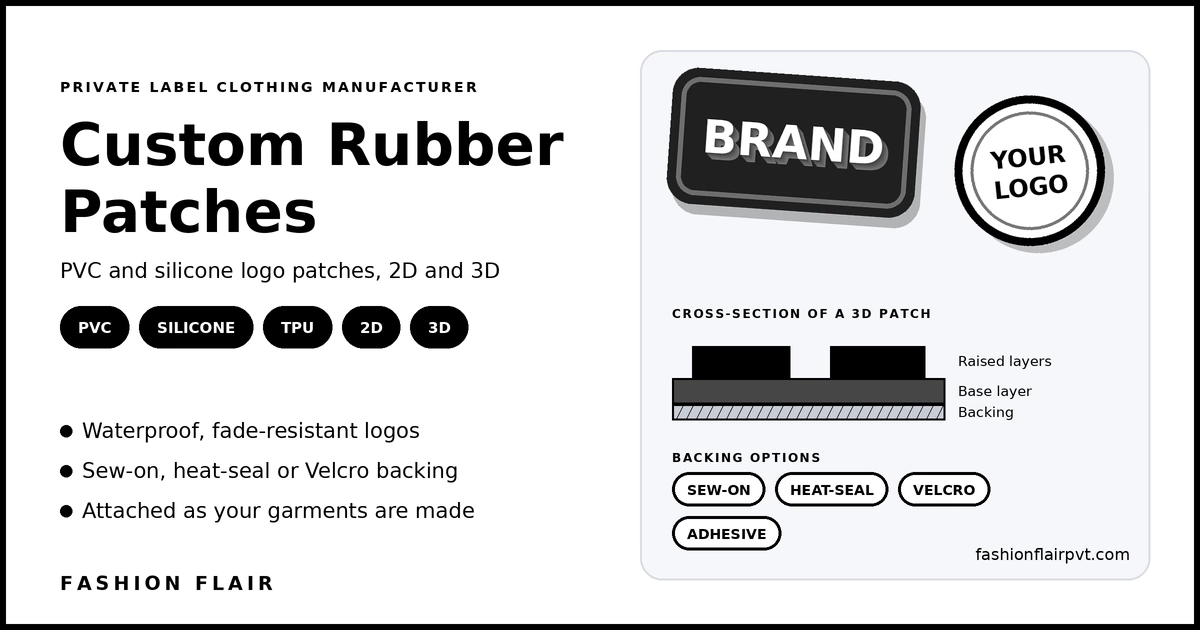
The surface is flat, with raised outlines or recessed areas dividing the colours. 2D patches suit simple logos, text and bold shapes, and they are the most cost-effective style. Best for: clean brand logos, uniforms and promotional wear.
3D Rubber Patches
Raised layers create a dimensional look, so parts of the logo stand above the rest. The result is bolder and more premium. Best for: streetwear logos, caps and premium collections.
Sew-On Rubber Patches
These carry a flange or fabric backing so they can be stitched onto the garment. Sewing gives the strongest, most permanent hold, which is why it is the usual choice for items that are washed often, such as hoodies, jackets and workwear.
Heat-Seal (Iron-On) Rubber Patches
An adhesive backing bonds to the garment with controlled heat and pressure. It is quick and gives a clean, stitch-free look. Heat must be controlled carefully, because too much can distort the patch.
Velcro Rubber Patches
A hook-and-loop backing lets the patch be removed or swapped, which is popular for tactical gear, uniforms and bags. The loop panel is sewn to the garment, and the patch attaches to it.
Adhesive Rubber Patches
A peel-and-stick backing suits items that cannot be sewn or heat-pressed, such as some bags and accessories. It is the least permanent option, so we do not recommend it for garments that are washed often.
Which Backing Should You Choose?
| Backing | Permanence | Best for |
|---|---|---|
| Sew-on | Permanent | Hoodies, jackets, caps and workwear |
| Heat-seal | Strong, stitch-free | Smooth fabrics and fast production |
| Velcro | Removable | Uniforms, tactical gear and bags |
| Adhesive | Temporary | Accessories and items that are not washed |
Rubber Patches vs. Embroidered, Woven and Leather Patches
| Patch | Look and feel | Best for |
|---|---|---|
| Rubber | Raised, glossy or matte, waterproof | Modern streetwear, outdoor and tactical wear |
| Embroidered | Stitched, textured, classic | Uniforms, varsity and heritage styles |
| Woven | Flat, fine detail | Small labels and detailed artwork |
| Leather and PU | Pressed, premium, natural look | Denim, jackets and hats |
An honest manufacturer of custom rubber patches will tell you when a different patch suits your brand better. If your style is vintage or varsity, embroidered or chenille patches may fit better. If you want a bold, weatherproof, modern emblem, rubber is hard to beat. Many brands use both on one collection.
Where to Use Custom Rubber Patches
- Hoodies and sweatshirts, on the chest, sleeve or back (see Streetwear)
- Jackets and outerwear, including varsity and bomber styles
- Caps and hats, on the front panel or side
- Bags and backpacks
- Sportswear and gym wear (see Sportswear)
- Workwear, uniforms and tactical gear
Design Tips for Custom Rubber Patches
- Keep details bold. Very thin lines and tiny text can fill in or lose definition. Thicker lines give a cleaner patch.
- Limit the number of colours. Each colour is filled separately, so fewer colours mean a simpler, more cost-effective patch.
- Choose 2D or 3D on purpose. 3D adds impact and cost. A simple logo often looks best in 2D.
- Think about size. Large patches feel stiff and heavy on thin fabric. Match the patch size to the garment.
- Pick the finish. Glossy catches the light. Matte feels softer and more premium.
- Place away from seams and zips. Flat areas give the best hold and the cleanest look.
- Add contrast. A patch that matches the garment colour disappears. Use colours that stand out.
How Custom Rubber Patches Are Made
- Artwork preparation. Your logo is cleaned up and adjusted so every line and colour can be moulded.
- Mould making. A mould is cut from the approved design. It controls the shape, edges and depth of every patch.
- Colour filling. The material is added to the mould colour by colour, matched to your references.
- Curing. Heat sets the material so it becomes solid and durable.
- Demoulding and trimming. The patch is removed, trimmed and cleaned.
- Backing. Your chosen backing, such as sew-on, heat-seal or Velcro, is added.
- Inspection. Each patch is checked before it moves on to the garment.
How Our Order Process Works
- Send your brief. Logo, patch size, style (2D or 3D), backing, colours, quantity and garment. Vector files (AI, EPS, PDF) are best.
- Artwork check and mockup. We check the design for moulding and send a free mockup.
- Sample. We make a sample patch so you can approve colour, depth, size and feel.
- Bulk production. Production begins only after your sign-off.
- Attachment. Patches are sewn, heat-sealed or fitted to the garments we make for you, at the agreed position.
- Quality control. See below.
- Packing and shipping. Garments are packed and shipped worldwide.
For the full picture of an order, read our manufacturing process and sample policy.
Our Quality Control
Quality control is what protects your brand when you order custom rubber patches. Every order goes through our three-level QC system. For rubber patches, the checks include:
- Colour accuracy against your approved sample and Pantone reference
- Edge and detail definition, with no blurred outlines or colour bleeding between sections
- Surface quality, with no bubbles, pits or rough edges
- Size and thickness against the approved sample
- Backing strength, checked on sample pieces
- Placement, measured from a fixed point (collar, hem or seam) on every garment
Rejected pieces are removed, not shipped.
Material Safety and Compliance
Some markets restrict certain chemicals in PVC and other materials, especially in children’s products. If you sell in the EU, UK, US or elsewhere with such rules, or your retailer requires phthalate-free materials or testing to a specific standard, tell us before production. We can then quote the right material. We make what you specify, and we do not give legal advice.
Caring for Rubber Patch Garments
Rubber patches are tough, but gentle care keeps them looking sharp. We recommend telling your customers to wash the garment inside out in cool or warm water, avoid very high heat in the dryer, and never iron directly on the patch, since heat can soften or distort it. We can add care instructions to your garment labels.
What Affects the Cost of Custom Rubber Patches
Every maker of custom rubber patches prices a little differently. We quote per project, because the price depends on a few clear factors:
- Mould, which is a one-time cost for each design and can be reused for reorders
- Size and thickness, since larger and thicker patches use more material
- 2D or 3D, because layered patches take more time
- Number of colours
- Material, whether PVC, silicone or TPU
- Backing type
- Quantity, as the mould and setup costs are spread across more pieces
For more on pricing, see our price guide. We give a written quote before any work starts, so there are no surprise charges.
Who We Make Custom Rubber Patches For
We work with clothing startups, streetwear and outdoor labels, sports teams and schools, and companies ordering branded apparel. Some customers order a first run to test a logo. Others come back every season with new designs. For a full brand build, see our private label clothing manufacturing service.
Why Brands Choose Fashion Flair for Custom Rubber Patches
- Patch and garment in one order. The team that makes your hoodie or jacket also attaches your patch, so placement stays consistent.
- Honest material advice. We recommend PVC, silicone or TPU based on your garment and budget, not the most expensive option.
- Sample before bulk. You approve the patch before production starts.
- Production updates. Photos and videos during the run.
- A registered company you can verify. Fashion Flair (SMC-Private) Limited, SECP Incorporation No. 0269917, FBR NTN E862604, SCCI membership C-4058.
- Worldwide shipping, with options and timelines shared before production.
Frequently Asked Questions
What is your MOQ for custom rubber patches?
Our MOQ is 30 pieces per design. Because each design needs its own mould, smaller runs cost more per piece, so we can advise on the most economical quantity for your budget.
What are rubber patches made of?
Most are made from soft PVC. Silicone and TPU are alternatives that feel softer or tougher. We help you choose based on the garment and budget.
Are rubber patches waterproof?
Yes. The material does not absorb water, which is why rubber patches are popular on rain jackets, bags and outdoor wear.
Will the patch crack, peel or fade?
A well-made patch on a suitable garment should hold up through regular wear and washing. Problems usually come from very high heat, harsh solvents, or the wrong backing for the fabric. We recommend the right material and backing for your use.
What is the difference between 2D and 3D rubber patches?
2D patches are flat with defined colour sections. 3D patches have layered, raised areas for a dimensional look. 3D costs more and suits bold logos.
Which backing is best?
Sew-on gives the strongest, most permanent hold. Heat-seal gives a stitch-free look. Velcro is removable. Adhesive is temporary. For garments that are washed often, we recommend sew-on or heat-seal.
Can rubber patches be sewn on?
Yes. Sew-on patches are made with a flange or backing designed for stitching.
Can you match my brand’s Pantone colours?
Yes. Send your Pantone references and we match the patch colours as closely as the material allows, then approve a sample with you.
What artwork files do you need?
Vector files (AI, EPS or PDF) are ideal. If you only have a sketch or a low-quality logo, our design team can redraw it for you.
Can I get a sample before bulk production?
Yes. We make a sample patch so you can approve colour, depth and size. See our sample policy for details on cost and timing.
Can I send my own blank garments to attach patches to?
No. We are a manufacturer, so we attach patches only to garments we make for your order. That keeps placement and quality consistent from the first piece to the last.
How long does production take?
It depends on mould complexity and quantity. Share your design or mockup and we will give you an exact turnaround, confirmed in writing before we start.
Do you ship internationally?
Yes. As a manufacturer of custom rubber patches working with brands abroad, we ship worldwide and share shipping options and estimated delivery times before production begins.
Ready to Add Custom Rubber Patches to Your Collection?
Send us your logo, the garment you have in mind and your target quantity. We will reply with a mockup and a clear quote within 24 hours on working days. Tell us about your project and see why brands choose us for custom rubber patches.
Or email info@fashionflairpvt.com